AI in Business: From Frontline to Leadership — How AI Is Changing Business Growth
Artificial intelligence is no longer something that belongs only to data scientists, developers, or large technology companies.
Today, AI can help the person answering a customer query, the salesperson preparing for a meeting, the manager analyzing performance, the marketing team finding customers, and the leadership team planning the next stage of growth.
That is the real story of AI in business.
It is not simply about replacing a manual task with a machine. It is about connecting everyday work, business data, decision-making, and strategy into a smarter system.
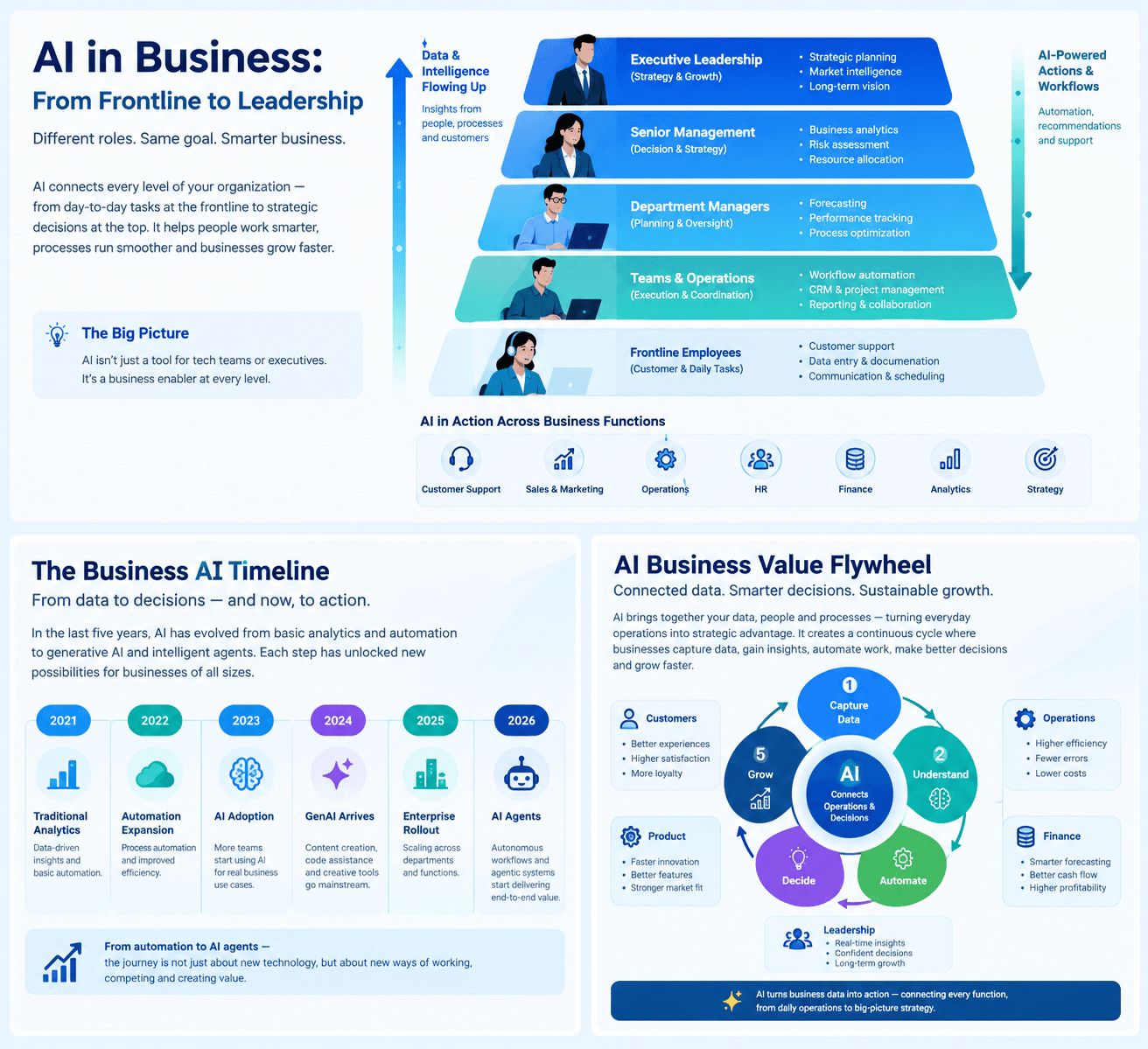
Daily Task → Team Workflow → Department → Management → Leadership → Business Growth

What Does “AI in Business: From Frontline to Leadership” Mean?
Think about a normal business.
A customer sends a question. An employee answers it. The interaction creates data. A manager later studies that data. The leadership team uses the information to make decisions about products, customers, pricing, or growth.
AI can participate at every stage.
For example:
- A customer-support employee can use AI to summarize conversations.
- A salesperson can use AI to research prospects.
- A marketing team can analyze customer behavior.
- An operations manager can forecast demand.
- A finance team can identify unusual transactions.
- An executive can use AI to analyze business scenarios.
The important change is that AI is moving from individual tools to connected business workflows.
How AI in Business Has Changed Over the Last Five Years
AI in business did not suddenly appear with ChatGPT.
Businesses were already using artificial intelligence for recommendation systems, fraud detection, forecasting, search, customer segmentation, automation, and computer vision.
What changed was accessibility.
Instead of requiring a specialized team to interact with AI, employees could increasingly communicate with AI using normal language.
The journey from 2021 to 2026
Period | Major Change | Typical Business Use |
|---|---|---|
2021 | Traditional AI + analytics | Forecasting, recommendations, fraud detection |
2022 | More automation | Customer service, computer vision, process automation |
2023 | Generative AI | Content, research, coding, summarization |
2024 | Production adoption | Marketing, support, software, employee assistants |
2025 | AI agents | Multi-step workflow automation |
2026 | Connected AI | AI across departments and business processes |
McKinsey reported that 56% of surveyed organizations had adopted AI in at least one business function in 2021. By 2024, Stanford's AI Index reported that 78% of surveyed organizations were using AI.
The exact adoption path differs by industry and company size, but the direction is clear: AI is becoming a business technology rather than only a technology experiment.

1. AI Starts With the Frontline Employee
The easiest way to understand how AI helps businesses is to look at everyday work.
Imagine a customer-service employee receiving dozens of requests every day.
Without AI, the employee may need to:
- Read the customer message.
- Search the knowledge base.
- Check previous conversations.
- Look up order information.
- Write a response.
- Update the CRM.
AI can assist with many of these steps.
Task | Traditional Process | AI-Assisted Process |
|---|---|---|
Customer support | Search information manually | AI retrieves relevant information |
Emails | Write from scratch | AI drafts responses |
Documentation | Manual notes | AI summaries |
Data entry | Copy/paste | AI extracts information |
Sales calls | Manual notes | AI-generated summaries |
Scheduling | Multiple messages | Automated scheduling |
The point is not simply to make employees work less.
The real goal is to give people more time for work that requires judgment, relationships, creativity, and problem-solving.
Real-world example: Klarna
Klarna reported that its OpenAI-powered assistant handled 2.3 million customer-service conversations during its first month, equivalent to around two-thirds of its customer-service chats.
The company also reported a reduction in average issue-resolution time from around 11 minutes to under 2 minutes.
The interesting part is that this was not simply a chatbot sitting on a website. AI was connected to an actual customer-service workflow.
Business lesson: Start with a real process, not simply the desire to “add AI.”
2. AI Helps Small Teams Do More
The next level is team productivity.
A small sales team might previously spend hours researching prospects, preparing emails, updating CRM records, and creating reports.
With AI, parts of that workflow can be connected:
Research → Lead Qualification → Personalized Outreach → Follow-up → CRM Update → Reporting
This is particularly important for AI for small business.
Small businesses normally have fewer employees and limited budgets. AI can provide access to capabilities that previously required additional staff, software, or external agencies.
Shopify: AI for merchants
Shopify's Sidekick is an example of AI being integrated into an e-commerce platform.
It can assist merchants with tasks such as analyzing data, managing products, generating content, creating customer segments, and handling administrative work through natural-language instructions.
This changes the equation for a small business owner.
Instead of asking:
“Can I afford a data analyst or marketing specialist?”
the business can increasingly ask:
“Which parts of this work can AI help me handle?”
That does not eliminate the need for people. It can make a small team more capable.
3. AI Turns Business Data Into Useful Decisions
As we move from employees to managers, the question changes.
Employees often ask:
“How do I complete this task?”
Managers ask:
“What is happening across my team or department?”
This is where business applications of AI become more analytical.
AI can help analyze:
- Sales performance
- Customer behavior
- Inventory
- Marketing campaigns
- Employee workloads
- Expenses
- Customer complaints
- Project performance
- Operational risks
Imagine an online business notices that sales have dropped 12%.
Instead of checking several separate reports manually, an AI-enabled analytics system could bring together authorized information from sales, inventory, marketing, and customer systems.
It might reveal a pattern such as:
Sales ↓ → Product stockouts ↑ → High-value customers affected → Campaign conversion ↓
The AI is not making the final business decision.
It is helping the manager reach the important information faster.
4. AI Is Changing Marketing and Sales
Marketing is one of the most visible areas for uses of artificial intelligence in business.
AI can support:
- Customer segmentation
- Personalization
- Lead scoring
- Content creation
- SEO research
- Campaign analysis
- Sales forecasting
- Product recommendations
- Customer-intent analysis
McKinsey's 2025 research identified marketing and sales among the business functions with significant generative-AI use.
Real-world example: Wipro Enterprises
Google Cloud reported that Wipro Enterprises uses Vertex AI and BigQuery to turn sales data into recommendations.
According to the company's published case study, the system generated recommendations associated with 15–20% increases in retail sales lines and helped identify 15,000 new outlets.
The larger lesson is important.
AI becomes much more valuable when it moves beyond content generation and becomes part of the sales decision-making process.
The growth loop becomes:
Customer Data → AI Analysis → Opportunity → Sales Action → New Data → Better Analysis
5. AI Can Improve Operations
AI is also changing the way businesses operate behind the scenes.
Common AI applications in business operations include:
- Demand forecasting
- Inventory optimization
- Predictive maintenance
- Document processing
- Procurement
- Logistics
- Fraud detection
- Workforce planning
- Quality inspection
But there is an important reality here:
AI does not automatically create profit.
A company can deploy an expensive AI system and still see little business value if its data is poor, the workflow is badly designed, or nobody measures the results.
That is why successful AI implementation usually connects:
AI + Data + Workflow + People + Measurement
6. AI Is Accelerating Product and Software Development
Software teams are another major example.
Developers can use AI for:
- Code generation
- Debugging
- Testing
- Documentation
- Refactoring
- Code review
- Research
- API integration
The business impact goes beyond writing code faster.
If development becomes faster, a company may be able to move through:
Idea → Prototype → Testing → Release → Customer Feedback
more quickly.
Siemens' Industrial Copilot is one example of generative AI being used in engineering environments to assist with automation code, documentation, and engineering workflows.
The broader trend is clear: AI is moving from office productivity into technical and industrial work as well.
7. AI Is Changing the Customer Experience
AI is also changing how customers discover and purchase products.
Traditional search often requires customers to know what they want.
AI allows them to describe their requirement naturally.
For example:
“I need a laptop for programming with good battery life and a budget of around $1,000.”
Instead of searching through hundreds of products, an AI system can interpret the requirement and help narrow down the options.
This creates a new customer journey:
Search → Discovery → Personalization → Recommendation → Purchase
Victoria's Secret, for example, worked with Google Cloud on an AI-powered visual search experience that allowed customers to upload an image and receive product recommendations.
This is where AI starts becoming part of the customer experience, rather than simply an internal business tool.
8. AI at the Enterprise Level
Large organizations face a different challenge.
They may have:
- Thousands of employees
- Multiple departments
- Millions of customers
- Hundreds of internal systems
- Huge volumes of data
- Regulatory requirements
For these organizations, the question is no longer simply:
“Can we use AI?”
It becomes:
“How do we use AI safely across the organization?”
Walmart is an example of a large organization investing in AI for employees, customer experiences, and retail operations.
This represents an important enterprise pattern:
AI for Employees + AI for Customers + AI for Operations
The challenge at this level is integration, security, permissions, governance, monitoring, and accountability.
9. AI as a Knowledge Layer
Some organizations have another problem: too much information.
Financial-services companies, for example, may have research documents, client information, internal policies, regulations, meeting notes, and product information spread across multiple systems.
AI can act as a natural-language layer over authorized information.
Morgan Stanley's AI @ Morgan Stanley Assistant is an example. The company said that by June 2024, 98% of Financial Advisor teams had adopted the assistant.
This illustrates an important shift.
AI is no longer only:
“Ask AI a question.”
It is increasingly becoming:
“Ask AI about the information and systems my organization has authorized it to access.”
This is one reason technologies such as RAG, enterprise search, APIs, data integration, and AI agents are becoming important in business.
10. AI Can Help Businesses Scale
Growth sounds exciting, but growth creates operational pressure.
More customers mean:
More orders → More questions → More support → More administration
If every new customer requires another employee, business growth can become expensive.
AI can potentially change that relationship.
Example: reMarkable
reMarkable reported using AI agents for customer support and internal IT support.
The company reported that its AI customer-service agent handled 37% of support cases in its deployment.
The basic idea is simple:
Customers ↑ → Repeatable work ↑ → AI handles suitable interactions → Humans handle complex cases
This does not mean humans disappear.
It means human attention can be concentrated where it creates more value.
11. AI From Management to Leadership
At the leadership level, AI plays a different role.
A CEO does not necessarily need AI to write another email.
The bigger opportunity is decision support.
AI can help leadership analyze:
- Revenue trends
- Customer behavior
- Market changes
- Pricing
- Operational risks
- Financial forecasts
- Competitor information
- Business scenarios
Imagine a business leader asking:
“What could cause our revenue to decline over the next six months?”
An AI system connected to authorized business data could analyze sales, customer behavior, inventory, finance, and other relevant information and present possible scenarios.
The decision still belongs to the leadership team.
AI provides speed, context, and analysis.
Humans provide judgment, accountability, relationships, and strategic direction.

AI Applications in Business by Department
Department | AI Applications | Potential Impact |
|---|---|---|
Customer Support | AI agents, summaries, knowledge assistants | Faster responses |
Sales | Lead scoring, research, recommendations | Better prioritization |
Marketing | Personalization, content, campaign analysis | Faster experimentation |
Finance | Forecasting, anomaly detection | Better visibility |
HR | Recruiting and employee assistance | Less administration |
Operations | Forecasting and automation | Process efficiency |
Supply Chain | Demand and inventory forecasting | Better planning |
Engineering | Coding, testing, documentation | Faster development |
Management | Analytics and scenarios | Faster decision support |
Leadership | Market intelligence and forecasting | Better access to insights |
How to Implement AI in Business
The biggest mistake is starting with:
“We need AI.”
Start with:
“Which business problem is costing us time, money, customers, or opportunities?”
A practical approach is:
1. Find the Problem
Identify a process that is slow, expensive, repetitive, or difficult to scale.
2. Map the Workflow
Understand:
Input → Process → Decision → Output
3. Select the Right Technology
Business Need | Possible Technology |
|---|---|
Generate content | Generative AI |
Search company knowledge | RAG / Enterprise Search |
Predict demand | Machine Learning |
Automate workflows | AI + Automation |
Understand images | Computer Vision |
Perform multi-step tasks | AI Agents |
Detect unusual behavior | Anomaly Detection |
4. Connect Business Data
AI becomes more useful when it understands authorized company information such as products, customers, orders, policies, documents, and operations.
5. Keep Humans Involved
Human review remains especially important when AI affects money, customers, legal matters, security, employment, compliance, or sensitive information.
6. Measure Results
Track metrics such as:
- Response time
- Manual hours
- Cost per transaction
- Conversion rate
- Error rate
- Customer satisfaction
- Revenue per employee
That is how an AI experiment becomes a measurable business case.
AI Adoption vs AI Transformation
There is an important difference between the two.
AI Adoption
An employee uses AI to write an email.
AI Transformation
A company redesigns its customer-service workflow around AI, connects it with authorized company knowledge, routes complex cases to humans, measures performance, and continuously improves the system.
The first is using an AI tool.
The second is changing how the business operates.
That distinction will become increasingly important as AI agents become more capable.
What the Future Looks Like: Humans + AI
The future of business is not simply:
Humans OR AI
It is:
Humans + AI
AI can provide:
- Speed
- Automation
- Pattern recognition
- Information processing
- Scale
- Personalization
Humans provide:
- Judgment
- Creativity
- Context
- Relationships
- Accountability
- Ethics
- Strategic direction
The companies building useful AI systems will not necessarily be the ones using the most AI.
They will be the ones that connect AI to real business problems, useful data, practical workflows, measurable outcomes, and responsible human oversight.
And that is ultimately what AI in business from frontline to leadership means:
AI starts with a small task, becomes part of a workflow, supports a department, helps managers understand the business, and eventually gives leadership a clearer view of where the organization can go next.
The goal is not simply to work faster.
It is to build a business that can understand faster, respond faster, learn faster, and grow more intelligently.